A Letter of Credit (L/C) is a bank-guaranteed payment instrument that protects both buyer and seller in international trade. It's the gold standard for securing large import transactions, especially with new suppliers.
How a Letter of Credit Works
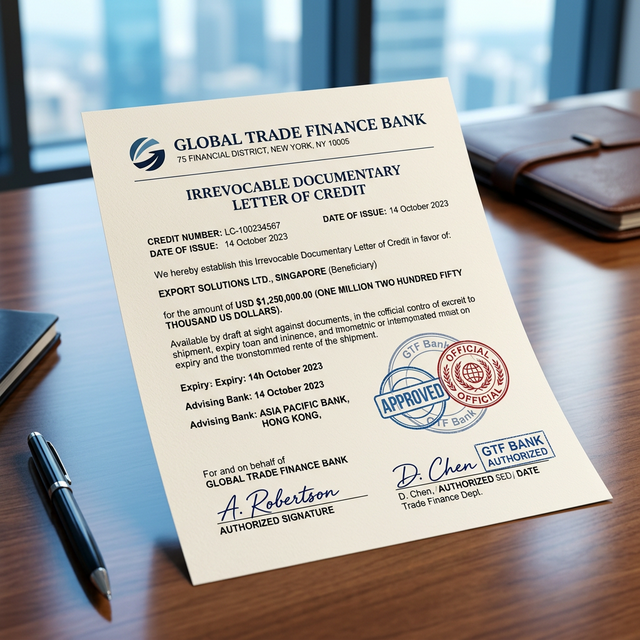
1. Buyer and seller agree on terms
2. Buyer applies for L/C at their bank (issuing bank)
3. Issuing bank sends L/C to seller's bank (advising bank)
4. Seller ships goods and presents documents to their bank
5. Advising bank checks documents and forwards to issuing bank
6. Issuing bank verifies documents and pays seller's bank
7. Buyer receives documents to clear cargo
8. Buyer [clears goods through customs](/services/clearing-and-forwarding/)
Types of Letters of Credit
| Type | Description | Use Case |
|---|---|---|
| Irrevocable | Cannot be modified without all parties' consent | Standard (most common) |
| Confirmed | A second bank also guarantees payment | High-risk countries |
| Sight L/C | Payment on document presentation | Immediate payment |
| Usance/Term L/C | Payment after a set period (30/60/90 days) | Deferred payment |
| Revolving | Automatically renews after each use | Regular, repeat orders |
| Standby | Acts as backup guarantee (not primary payment) | Performance guarantee |
| Transferable | Can be transferred to a third party | Middlemen/traders |
Required Documents for L/C
Your L/C will specify exactly which documents the seller must present. Common requirements:
- ✅ Commercial invoice — Matching L/C description exactly
- ✅ Bill of lading — Shipped on board, clean, in consignee's name
- ✅ Packing list — Matching invoice quantities
- ✅ Certificate of origin — For preferential duty claims
- ✅ Insurance certificate — If CIF terms
- ✅ Inspection certificate — If required by buyer
- ✅ HS code declaration
Common L/C Discrepancies
Banks reject documents with even minor errors. The most common discrepancies:
| Discrepancy | Example |
|---|---|
| Late shipment | Shipped after L/C expiry date |
| Description mismatch | L/C says "100% cotton" but invoice says "cotton blend" |
| Amount mismatch | Invoice total doesn't match L/C amount |
| Late presentation | Documents submitted more than 21 days after shipment |
| Incorrect B/L | Bill of lading not "shipped on board" or not clean |
| Missing documents | Any required document not included |
L/C Costs
| Fee | Typical Cost | Who Pays |
|---|---|---|
| L/C issuance | 0.5-2% of L/C value | Buyer |
| Advising fee | R3,000-R10,000 | Usually seller |
| Confirmation fee | 0.5-3% per annum | Buyer or seller |
| Amendment fee | R2,000-R5,000 | Requester |
| Negotiation fee | 0.1-0.3% | Seller |
| SWIFT charges | R500-R2,000 per message | Both |
When to Use vs Not Use L/C
Use L/C when:
- First-time supplier in a new country
- Large order values (R500,000+)
- Supplier requires guaranteed payment
- Trading with countries where legal enforcement is difficult
Skip L/C when:
- Established, trusted supplier
- Small order values (cost of L/C exceeds risk)
- SADC trade with proven partners