Exporting from South Africa opens your business to global markets. Whether you're shipping agricultural products to Europe, automotive parts to Asia, or mining equipment across Africa, this guide covers the full export process.
Step 1: Register as an Exporter
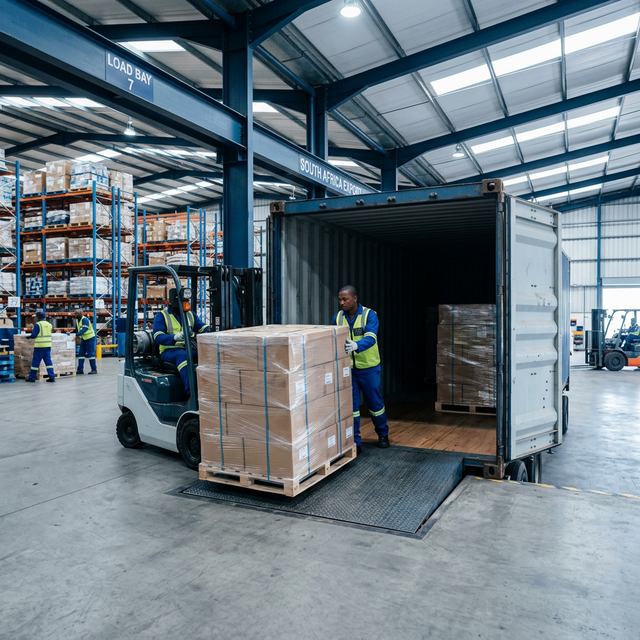
Before exporting, you need:
- SARS customs registration — Register as a customs client to get your customs code
- Company registration (CIPC) if trading as a business
- Tax clearance from SARS
- Industry-specific licences if exporting controlled goods
Step 2: Find Buyers and Markets
Research your target markets:
- Europe — SA's largest export market, benefits from EU EPA trade agreement
- African markets — SADC and cross-border opportunities
- Asia — Growing demand for SA minerals, agricultural products
- USA — AGOA trade preferences for qualifying goods
Step 3: Agree on Trade Terms
Negotiate Incoterms with your buyer:
- FOB (Free On Board) — You deliver to the port; buyer arranges freight
- CIF (Cost, Insurance, Freight) — You pay freight and insurance to destination
- DAP (Delivered at Place) — You deliver to the buyer's location
- EXW (Ex Works) — Buyer collects from your premises
Step 4: Prepare Export Documentation
Essential documents:
- ✅ Commercial invoice with accurate product descriptions and values
- ✅ Packing list with weights, dimensions, contents
- ✅ Certificate of origin — critical for SADC and EU preferential tariffs
- ✅ Bill of lading or airway bill
- ✅ Export permit (if required for controlled goods)
- ✅ Phytosanitary certificate (agricultural exports)
- ✅ SABS/NRCS certificates (if required by destination)
Step 5: Arrange Freight
Choose your transport mode:
- Sea freight — FCL or LCL from Durban Port
- Air freight — via King Shaka Airport
- Road freight — for cross-border African destinations
V & S Freight handles all freight booking and coordination. Get a quote →
Step 6: Customs Clearance
Your clearing agent (V & S Freight) submits the export declaration (SAD 500) to SARS via EDI:
- Export entry submitted electronically
- SARS processes and approves
- Goods are released for export
- Cargo loaded onto vessel/aircraft/truck
Export clearance is generally faster than import clearance — typically same day with correct documentation.
Step 7: Get Paid
Common payment methods for exports:
- Advance payment — Buyer pays before shipment (lowest risk for you)
- Letter of credit — Bank guarantees payment
- Documentary collection — Bank handles document exchange
- Open account — Buyer pays after receiving goods (highest risk)
Key Export Industries in South Africa
| Industry | Top Products | Key Markets |
|---|---|---|
| Mining | Gold, platinum, coal, manganese | China, India, Europe |
| Automotive | Vehicles, components | Europe, Africa, USA |
| Agriculture | Citrus, wine, sugar, maize | Europe, Middle East, Asia |
| Manufacturing | Steel, chemicals, machinery | Africa, Europe |
Export Incentives
- SADC preferential tariffs — Reduced duty for exports to member states
- EU EPA — Preferential access to European markets
- AGOA — Duty-free access to US markets for qualifying goods
- Export marketing assistance — dtic export incentives